
Stepping into the world of sewing is an exciting adventure filled with creativity and the promise of making something unique with your own hands. However, walking into a craft store can be overwhelming for a beginner, with walls of specialized tools and notions. It’s hard to know where to even begin your shopping list without buying things you don’t truly need.
The good news is that you don’t need to purchase everything at once. A well-curated starter kit of essential accessories is all it takes to set yourself up for success and make the learning process smooth and enjoyable.
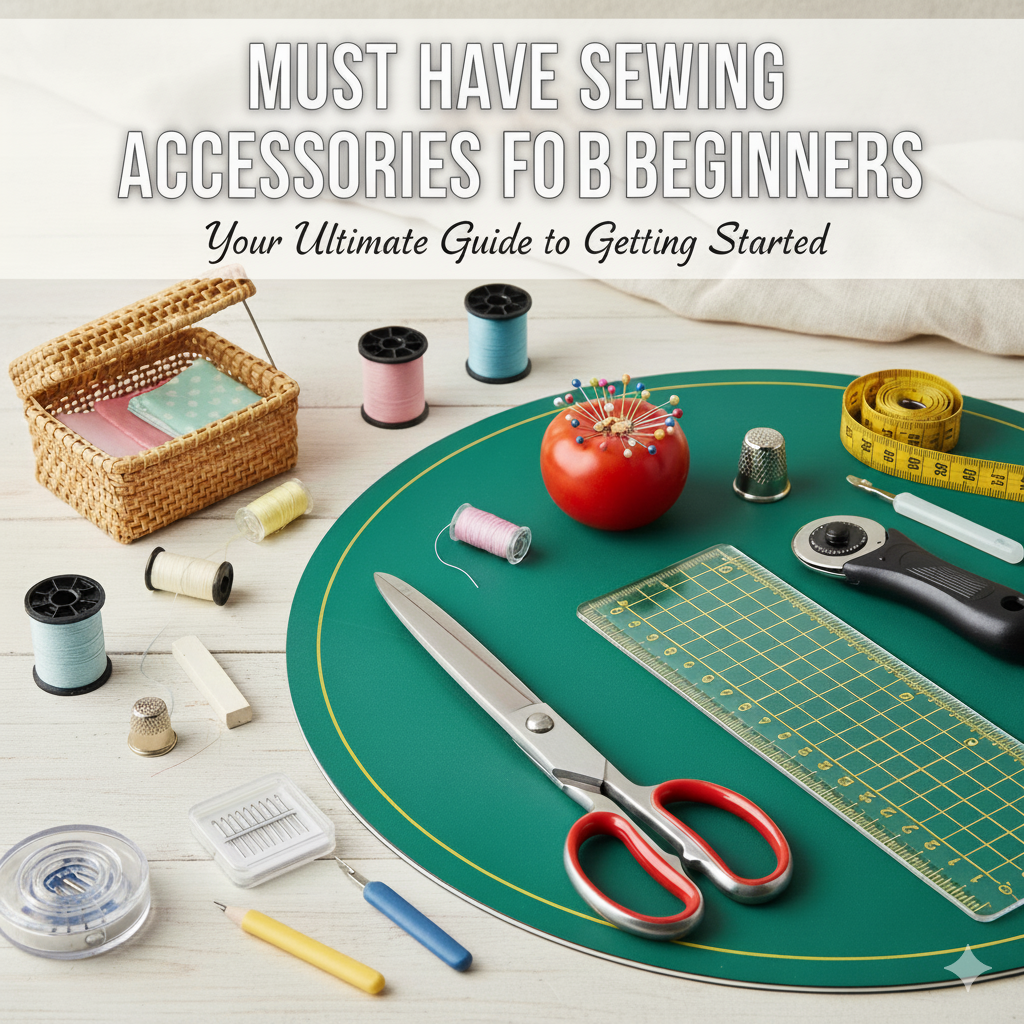
This guide is designed to cut through the clutter and introduce you to the top 30 must have sewing accessories for beginners. I’ve focused on the fundamental tools that you will use again and again, from the indispensable seam ripper that gracefully corrects mistakes to the pressing tools that are the secret to a professional-looking finish.

Consider this your trusted checklist to build a solid foundation for your new hobby, ensuring you invest in the right items that will help you create beautiful projects with confidence. Let’s get started!
30 Must Have Sewing Accessories
Quick Navigation Menu
Cutting Tools: The Foundation of a Good Project
1] Dedicated Fabric Shears:
Detail & Tips: These are your most important tool. High-quality shears have one sharp blade that slides past the other for a clean cut. Cheap scissors will crush the fabric fibers instead of slicing them.
Pro Tip: Hold the fabric up slightly off the cutting table with your non-cutting hand and let the weight of the scissors do the work for long cuts. This gives you a cleaner cut than trying to cut on a flat surface. Never, ever use them on paper—it dulls the blades instantly.
2] All-Purpose Scissors:
Detail & Tips: This is your “everything else” pair. Use them for cutting out paper patterns, tape, ribbon, or even plastic packaging. Clearly mark them with tape so they don’t get mixed up with your fabric shears.
3] Seam Ripper:
Detail & Tips: This isn’t just for mistakes; it’s for carefully removing basting stitches or opening a seam you need to adjust. The sharp hook is designed to slide under a stitch.
Pro Tip: Place the fabric on a flat surface and gently slide the sharp point under a single stitch. Push forward to cut it. For a long seam, turn the fabric over and rip from the bobbin thread side—it often comes out faster. Go slow to avoid snipping the fabric itself.
4] Thread Snips:
Detail & Tips: These are incredibly lightweight and designed for quick, one-handed use. Their small size makes them perfect for trimming threads close to the knot without risking a cut in your project.
Pro Tip: Keep them on a retractable lanyard attached to your sewing table or sewing machine. You’ll never lose them in your fabric pile again.
5] Pinking Shears:
Detail & Tips: The zigzag cut they create leaves less of a straight thread line to fray. They are not a substitute for a proper seam finish but are great for finishing raw edges inside garments where a serger isn’t available, especially on stable fabrics like cotton.
Pro Tip: Make sure the blades are fully closed with each cut for a clean pinked edge. Don’t try to cut through more than two layers of medium-weight fabric at once.

6] Appliqué Scissors:
Detail & Tips: Also called “duck-bill” scissors, the unique design has one blunt blade that slides under the top layer of fabric, protecting it while the sharp blade trims away the excess underneath.
Pro Tip: Essential for trimming seam allowances after applying appliqué or for understitching on facings to get a super clean, close trim.
7] Rotary Cutter:
Detail & Tips: This tool offers speed and precision, especially for straight lines and curves. It looks like a pizza cutter for fabric.
Pro Tip: Always cut away from your body. Apply firm, even pressure and roll it smoothly. Safety First: The blade is extremely sharp. Always retract the blade the moment you set it down.
8] Self-Healing Cutting Mat:
Detail & Tips: The mat protects your table and has a grid that helps you cut perfect 90-degree angles. The “self-healing” material closes up after the rotary cutter blade passes through, preventing grooves from forming.
Pro Tip: Use the grid lines to align the straight grain of your fabric (the selvage) before cutting. This ensures your garment pieces hang correctly. Check Out Amazons Full Line of Sewing Accessories Here
Measuring and Marking Tools: Accuracy is Everything
1] Flexible Measuring Tape:
Detail & Tips: Made of vinyl-coated fiberglass, it won’t stretch out over time like some cloth tapes. The double-sided printing allows you to read it from any angle.
Pro Tip: When taking body measurements, make sure the tape is snug but not tight, and parallel to the floor. Don’t hold your breath!
2] Seam Gauge:
Detail & Tips: This simple tool is a tiny workhorse. The sliding marker lets you set a specific measurement (like a 5/8″ seam allowance or a 2-inch hem) and quickly check it all around your project.
Pro Tip: Use the pointed end of the slider to gently nudge a seam open while pressing for a super crisp finish.
3] Clear Quilter’s Ruler:
Detail & Tips: Typically 6″ x 24″, this ruler is used with a rotary cutter. The grid, often with 45-degree angle lines, allows for mathematical precision.
Pro Tip: To cut a perfect strip, align a horizontal grid line with the folded edge of your fabric. This guarantees a straight cut, even if your initial fabric edge was crooked.
4] Hip Curve Ruler:
Detail & Tips: This ruler is used for pattern drafting and adjustment. The long, gentle curve matches the shape of the human hip.
Pro Tip: Use it to true up or smooth the curve of a side seam on a skirt or pants pattern, ensuring a graceful line from waist to hip.
5] French Curve Ruler:
Detail & Tips: Essential for shaping armholes, necklines, and sleeve caps. It connects points with a smooth, natural-looking curve that would be difficult to draw freehand.
Pro Tip: When adjusting a pattern, use the French curve to blend between different sizes (e.g., a size 10 at the bust to a size 12 at the waist).

6] Fabric Marking Pens/Chalk:
Detail & Tips: Test on a scrap first! Water-soluble pens disappear with a dab of water. Air-soluble pens fade in 24-48 hours. Tailor’s chalk brushes or washes away.
Pro Tip: For dark fabrics, a chalk wheel or white ceramic pencil is your best bet. For light fabrics, a fine-line water-soluble pen is perfect for accuracy.
Stitching Essentials: The Heart of Sewing
1] High-Quality All-Purpose Thread:
Detail & Tips: Cheap thread is fuzzy, has more lint, and breaks easily, causing frustration. Good thread (like Gutermann or Mettler) is smooth and strong.
Pro Tip: Polyester thread has a little stretch and is strong, making it ideal for most knit and woven projects. Cotton thread is best for 100% cotton fabrics where you want no stretch, like quilting.
2] Assorted Hand-Sewing Needles:
Detail & Tips: Needles come in sizes (lower number = thicker needle). Use a “sharps” needle for general sewing and a “between” for fine work like hemming.
Pro Tip: To thread a needle easily, cut the thread with sharp snips (a ragged end is hard to thread) and hold the needle against a white background.
3] Sewing Machine Needles:
Detail & Tips: The number one cause of sewing machine problems is a dull or bent needle. Change your needle every 8-10 hours of sewing or at the start of every new project.
Pro Tip: Match the needle to the fabric: Universal (most wovens), Ballpoint/Jersey (for knits), Denim (for thick fabrics), Microtex (for silks and fine fabrics). Check Out Amazons Line of Sewing Machine Needles Here
4] Glass-Headed Pins:
Detail & Tips: The glass heads are heat-resistant, so if you accidentally press over them, they won’t melt plastic into your iron. They are also easier to see and grab.
Pro Tip: Pin perpendicular to the seam line, within the seam allowance. This allows the fabric to lie flat as it feeds under the presser foot.
5] Pin Cushion:
Detail & Tips: The classic tomato pin cushion often comes with a small strawberry filled with emery powder. This “strawberry” is used to sharpen and clean your pins and needles—run the tip through it a few times.
6] Magnetic Pin Holder:
Detail & Tips: A powerful magnet holds pins securely. It’s fantastic for quickly picking up pins after you’ve sewn a seam.
Warning: Keep it far away from your computerized sewing machine, as magnets can interfere with the electronics.
7] Sewing Clips (e.g., Wonder Clips):
Detail & Tips: These are indispensable for bag-making, quilting, or sewing with vinyl/leather where pins would leave permanent holes. They hold layers firmly without distortion.

Pro Tip: Use them to hold bias binding in place perfectly while you stitch.
8] Bodkin:
Detail & Tips: There are two main types: one with pincher-like claws to grab the elastic, and one with a safety-pin-style loop. The claw kind often provides a stronger grip.
Pro Tip: Tape the end of the elastic to a point with Scotch tape to make it easier to thread through the casing even without a bodkin.
9] Point Turner and Seam Creaser:
Detail & Tips: The pointed end (often wood) is gently pushed into corners like on a collar to get a sharp point without poking through the fabric. The notched end is used to help open seams while pressing.
Pro Tip: For a super crisp corner, press the seam first, then use the point turner, and press again.
10] Thimble:
Detail & Tips: Wear it on the middle finger of your sewing hand. It allows you to push the needle through tough layers using the side of the thimble, not your fingertip.
Pro Tip: If a traditional thimble feels awkward, try a leather or silicone “stick-on” thimble that adheres to your finger.
Pressing Tools: The Secret to a Professional Finish
1] Iron and Ironing Board:
Detail & Tips: Pressing is not the same as ironing. Ironing involves sliding the iron back and forth. Pressing means lifting the iron up and placing it down on the seam, using steam and pressure, then lifting and moving to the next section. This prevents distortion. Check out Amazons Irons Here
2] Pressing Cloth:
Detail & Tips: A simple piece of muslin or silk organza works perfectly. Place it between your iron and the fabric to prevent shine on dark fabrics or scorching on delicate ones.
Pro Tip: You can also use a press cloth when applying fusible interfacing to prevent sticky residue from getting on your iron.
3] Tailor’s Ham and Sleeve Roll:
Detail & Tips: A tailor’s ham is a firmly stuffed, ham-shaped cushion used for pressing darts and curved seams. The sleeve roll is for pressing long seams like trousers or inside sleeves without creating creases on either side.
Pro Tip: When pressing a dart, place the ham under the fabric so the dart curves over the ham. This preserves the 3D shape of the garment.
4] Seam Roll:
Detail & Tips: This narrow roll allows you to press a seam open without the edges of the seam allowance leaving an impression on the right side of the fabric.
Other Helpful Notions
1] Bobbins:
Detail & Tips: Use the bobbins designed for your specific machine brand. Using the wrong type can cause tension issues. Pre-wind a bunch of bobbins with your essential thread colors at the start of a big project.
2] Loop Turner:
Detail & Tips: This is a long, thin wire with a hook on the end. You hook the end of your fabric tube, then pull the tool through, turning the tube right-side-out as you go.
Pro Tip: For very narrow tubes, attach a safety pin to one end and carefully work it through instead.
This comprehensive guide should give you the confidence to not only acquire these tools but to use them like a pro, leading to beautifully finished sewing projects
Related Reading
Best Sewing Tables for Small Spaces: Compact & Functional Designs